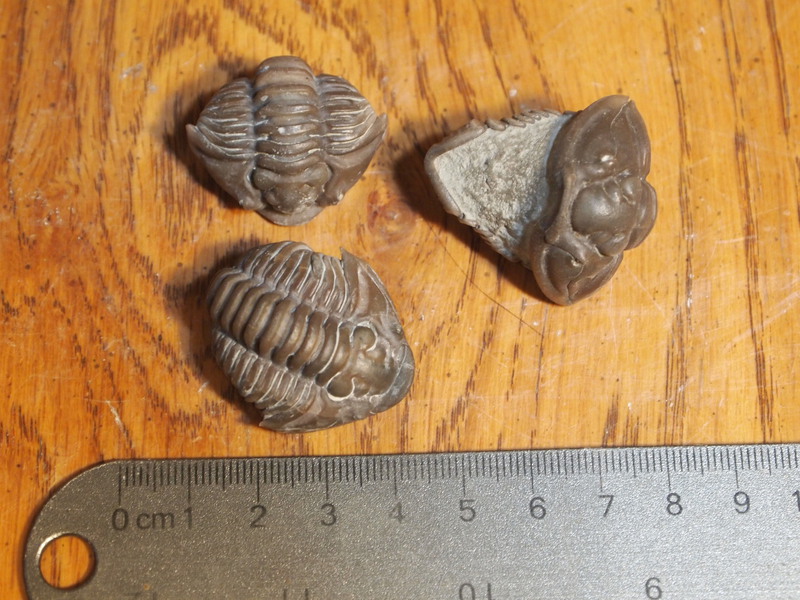
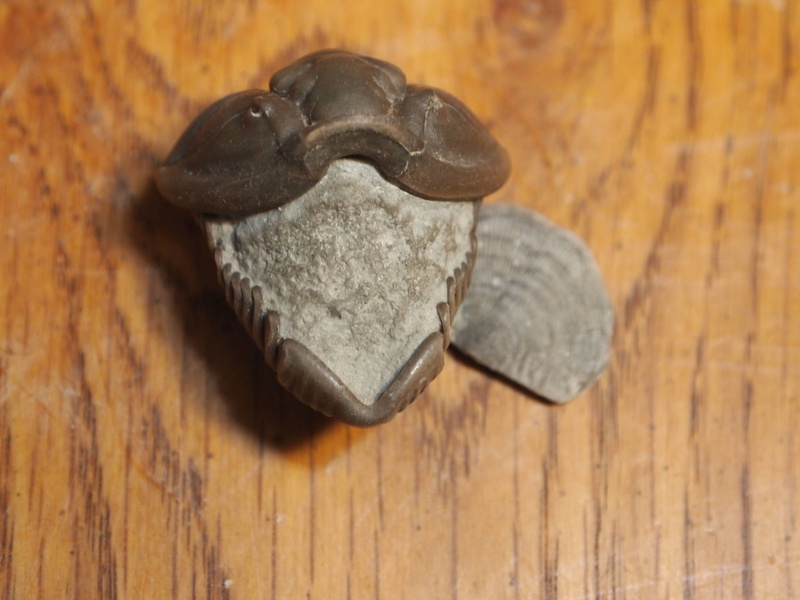
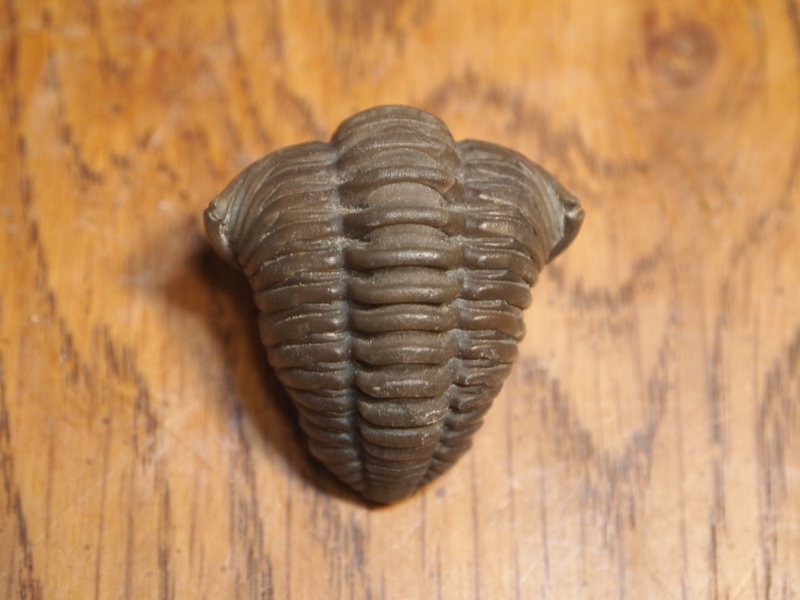
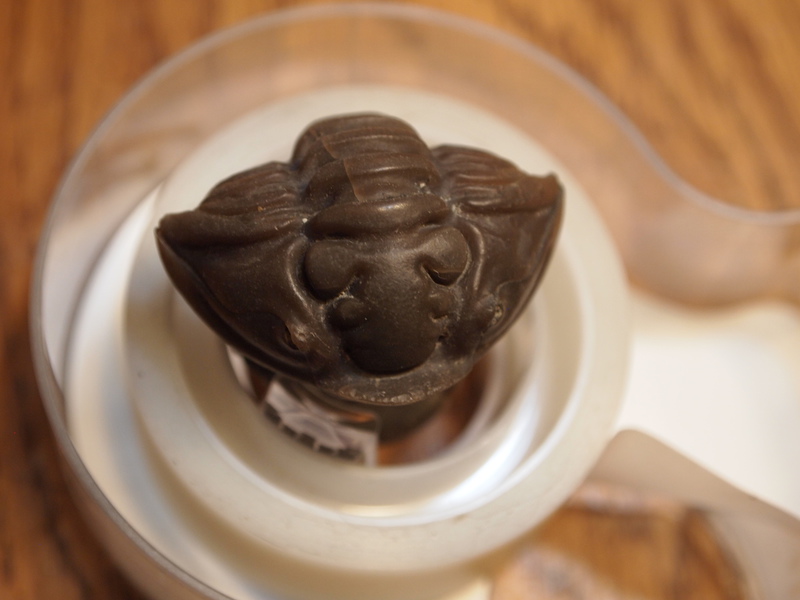
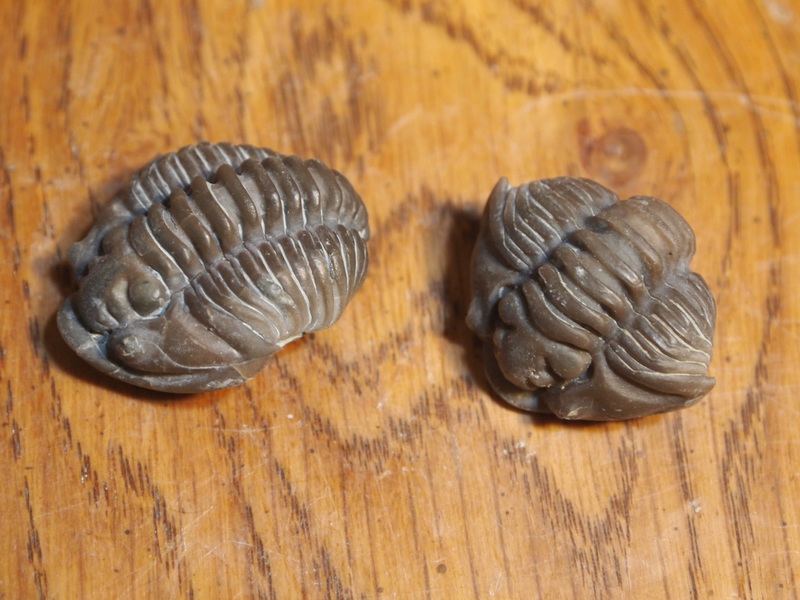
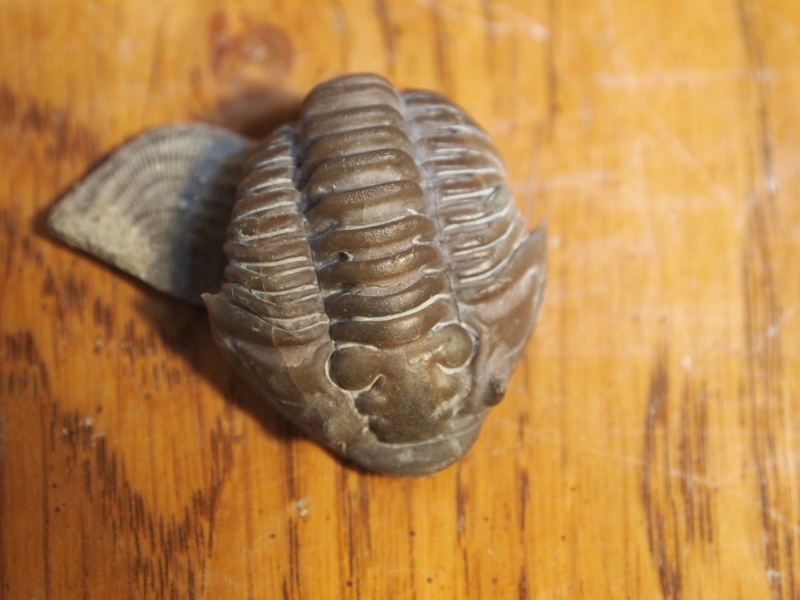
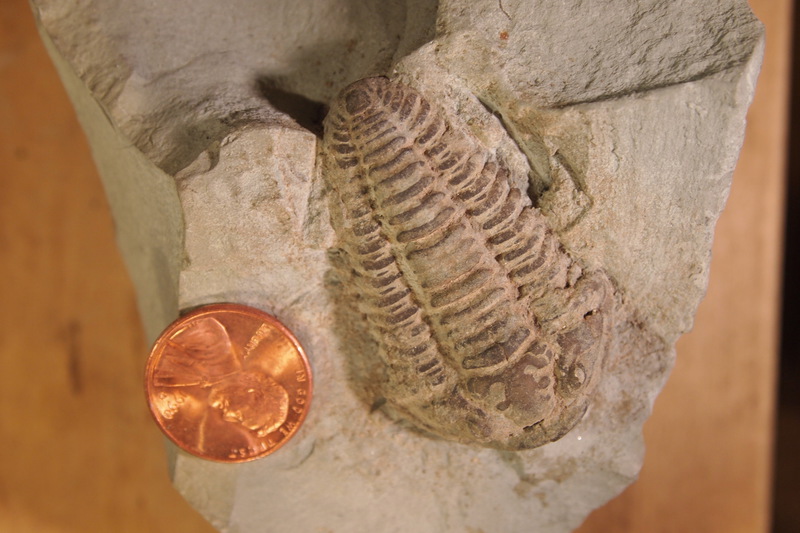
These three trilobites are Flexicalymene meeki from the Upper Ordovician Corryville member within the Maysville group of the Cincinnatian series. The smaller two on the left were the largest enrolled individuals collected during the excavation of two particularly unique blue grey shale layers within the Bushelman Quarry in Sharonville,Ohio. They were both found by a friend of mine Doug Benton that I was later obliged to have. The larger arched enrolled Flexicalymene was the first trilobite that I ever really found complete, and I think that it is the best one that I ever found. It was discovered at a well known historical site east of Cincinnati known as Stonelick Creek, which has since become part of a park. I was taken there on a field trip when I was taking Paleontology at the University of Cincinnati during my junior year. The teaching assistant walked us to the creek which had a road crossing that we had come over to park. We walked to the downstream side of the crossing and then we were told some things about the site. I learned that a rare aglaspid had been found there by a student who donated it to Dr. Ken Caster who was still at U.C. at the time, although Dr. David Meyer was teaching paleontology then during his first year there. Though I did take classes of Historical geology and Plate Tectonics from Dr. Caster who retired soon afterward. After the orientation was given, the assistant headed downstream with the class. I was not impressed by the float rock within the stream, so I decided to head upstream by myself, and after walking beneath the road crossing, I soon saw a low bank on the other side of the creek with some bedding, so I decided to walk across the creek through the shallow water covering my feet over maybe a 30 foot distance to the other side. As I began to approach the far edge, I saw the enrolled trilobite lying within the water amongst a lot of small pebbles. I picked it out of the water and turned it over to find that it was complete. Afterward I looked at the exposure, but that was the only trilobite that I found that day. I did come back to the creek a few times and found a thin layer with occasional prone Flexicalymene trilobites that were nice, and on one of those days my friend Doug Benton uncovered an Iocrinus subcrassus crinoid colony further upsteam within a cutbank on the other side of the creek, which would be another story. The lengthy crinoids were in place, smothered by sediment during a storm, with an enrolled 8 inch Isotelus maximus trilobite snagged within the stems. There were also two Flexicalymene trilobites within the colony, each with one or two Trematis brachiopods covering the head, one over an eye. I have never observed trilobite carcuses with inarticulate brachiopods on them, nor such an example of rapid catastrophic burial within the Cincinnatian as I saw that day, as between the three of us that were present, we excavated the crinoid assemblage which was about three feet wide from the shale that afternoon. The large Flexicalymene shown here that I found in the water near the edge of the creek I later showed to our teaching assistant when back on the bus, and his jaw just dropped. Dr. Meyer had recently acquired an ultrasonic bath which he allowed me to use within his back office to remove the remaining sediment that adhered to the exoskeleton, as the shale within the trilobite is rather hard and completely insoluable. Since the ultrasonic cleaning worked so well, the trilobite has never been touched by an air abrasive machine. So considering that this was my first complete Flexicalymene meeki trilobite, and my first found trilobite, and that it was lying in a creek bed among some gravel within a few inches of water, it seems as if it should not have been able to be found in that way. Nothing else has ever been found like that for me.
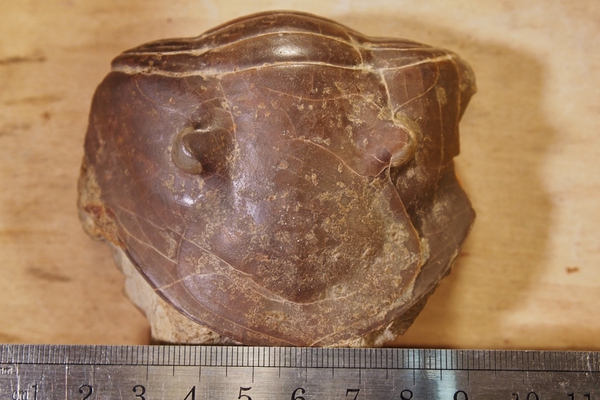
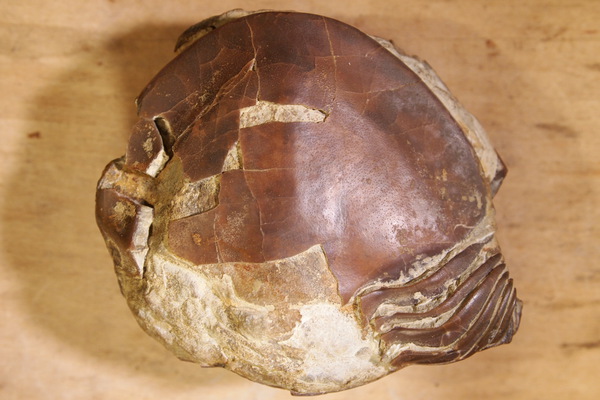
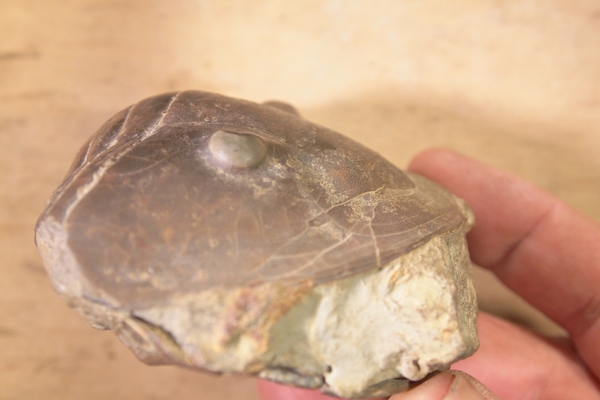
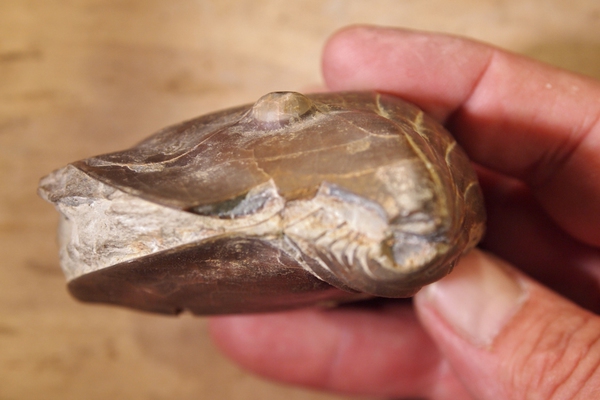
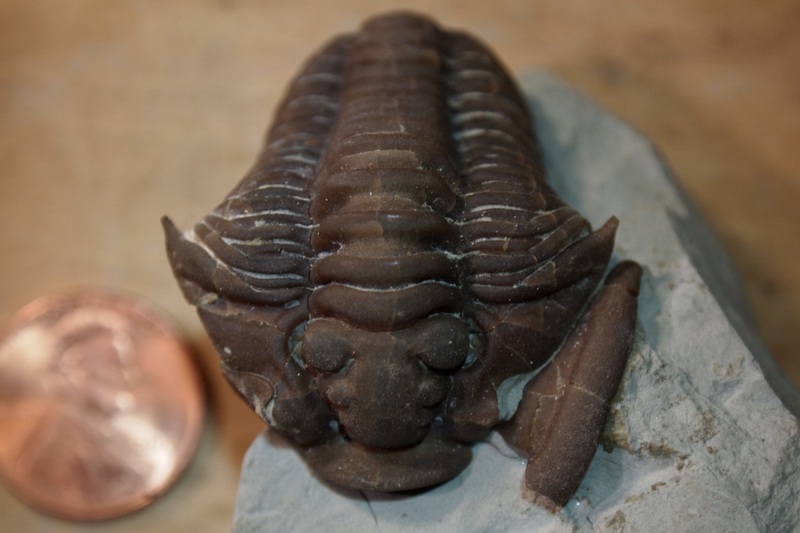
This is the largest Isotelus maximus trilobite that I have ever found and it is also from the Bushelman Quarry. I was taken to the quarry initially during a Saturday field trip while attending Miami University of Ohio in order to obtain a master's degree. Dr. Roy Rinehart taught biostratography, and the class primarily consisted of Saturday field trips. There were also a few field trips that I was taken on by my Sedimentology professot Dr. Wayne Martin. He was the student that found that aslaspid at Stonelick Creek believe it or not, and his story was that Dr. Caster looked at it on site when he found it, and remarked "You don't want this, do you?" and that was how the donation came to be. But both of these men were influential to my learning in the field. Little did I know until years following graduation that Dr. Rinehart was in the Battle of the Bulge as cited in his obituary, and that Dr. Martin was on a ship at Pearl Harbor during the attack. I was visiting him at his home, showing him some of the trilobites I had found at Ike's Canyon within the Ordovician of Nevada, and among them an aglaspid that I had found there. We walked into his home office and I noticed the photos on the wall of the ships and Pearl Harbor. After then learning that he was there during the attack, he proceeded to tell me all about it over the next ten minutes. I do not remember many of the details, only that one ship was laden with fuel and was flanked by other ships to prevent it from being hit. He said it would have been even worse if that had happened. But now back to the initial visit to Bushelmans, all of my classmates found a trilobite that day except me. One of the students named Becky found a complete starfish right side up on a brownish limestone plate atop a small spoil pile of rock within the first ten minutes of our being there. It was about three inches across and and in a perfect inflated posture. She immediately donated it, and if it is not within the museum at the university, it should be as it was beautiful. My good fortune was that the quarry was only about 8 miles from the house I was living in within the suburb of Wyoming outside the city limits of Cincinnati. I was commuting 30 miles to get to my classes at Miami University. But I was only driving 8 miles to go hunt trilobites after learning about Bushelmans. And it is also amusing that I was in grade school with one of the Bushelman girls, and that it was her uncle that owned the quarry. Well, I returned there a number of times before finding the trilobite layers that were mined, and on one visit, I found this enrolled Isotelus lying near the top of a small spoil pile similar to how the starfish was found. The pygidium was showing, and I was hoping it would have the rest of the body, but as I turned it over in my hand I did not expect to see the head so nicely preserved, and I kissed it. I had seen something similar once, maybe at the Cincinnati museum that had this type of preservation. It is similar to what the old timers found within the butter shales of the Corryville member around Cincinnati during the 19th century. Those beds have long been gone, as well as some of the highest topographic landforms within the Cincinnnati area, such that the geologic record can no longer be observed as it once was. I have concluded that the trilobite beds excavated during the mining at Bushelmans laid within a tidal channel. The two blue grey blocky shale units roughly 8 inches thick each, were separated by a one inch calcareous shale layer, and extended approximately a couple hundred feet across the quarry hillside before lensing out abruptly into the massive brown shales over just a few feet on either side, with the brown shales extending another 20 feet further upward reaching the top of the exposure. I think it is likely that similar channels followed along the tops of the highest exposures around Cincinnati, and that they were the means of distribution of the fine sediments which dominate the Cincinnatian shales. I believe that the brown shales evidence the existance of iron, although I have not done an analysis. The grey shale within the channel is likely devoid of iron as the iron would precipitate outside of the channel. The fine clay would be left over that would drift into the basin and produce a muck, as it often did I think. And there should then be a sequence of environments proceeding down into the basin with distinctive assemblages reflecting their positions along the gradient. There is some discussion about the fauna at Bushelmans within the thesis I completed at Miami U., but my advisor did not want me to include this interpretation without further evidence. And he also never visited the outcrop to see for himself. Isn't science wonderful. Now the outcrop at the quarry is buried so no one will ever see it unless it is reexposed. There is great potential there.
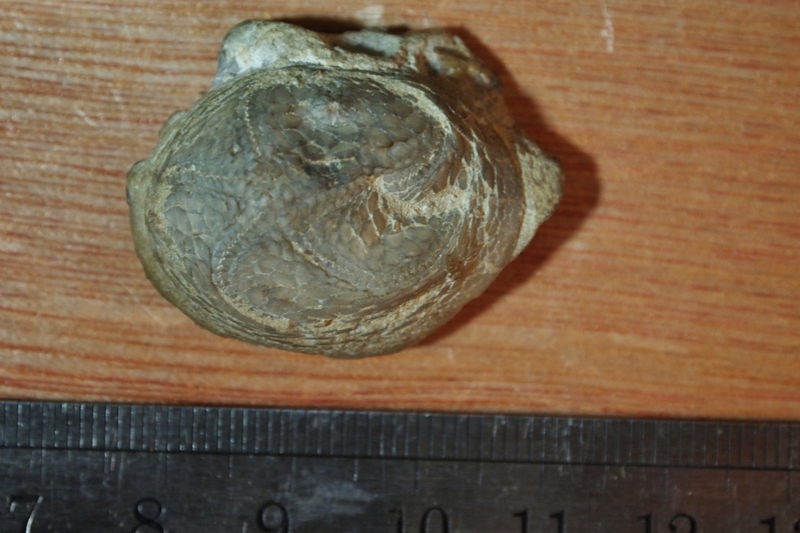
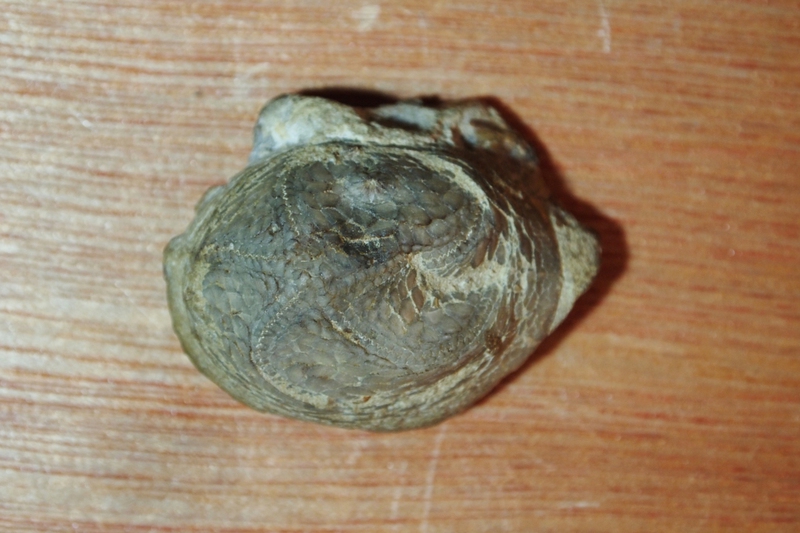
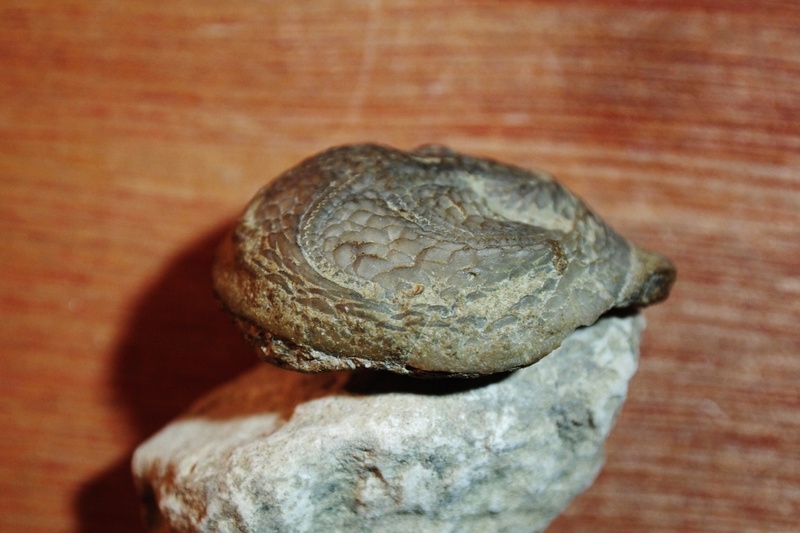
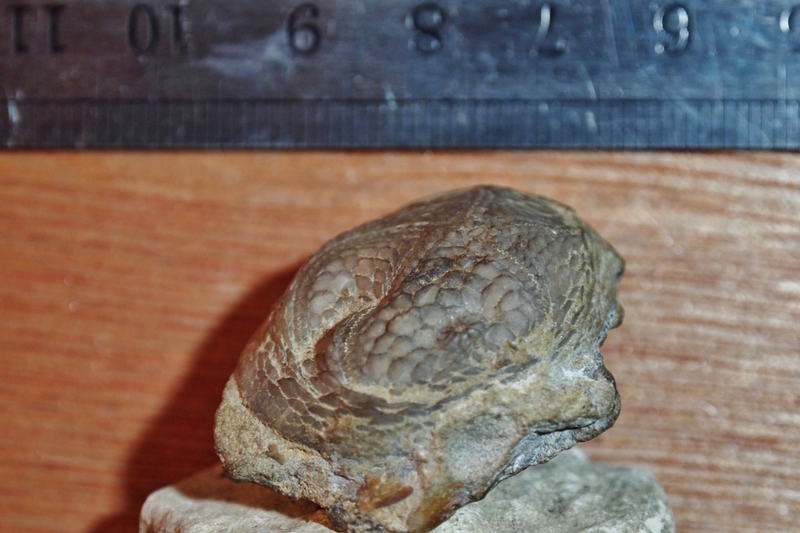
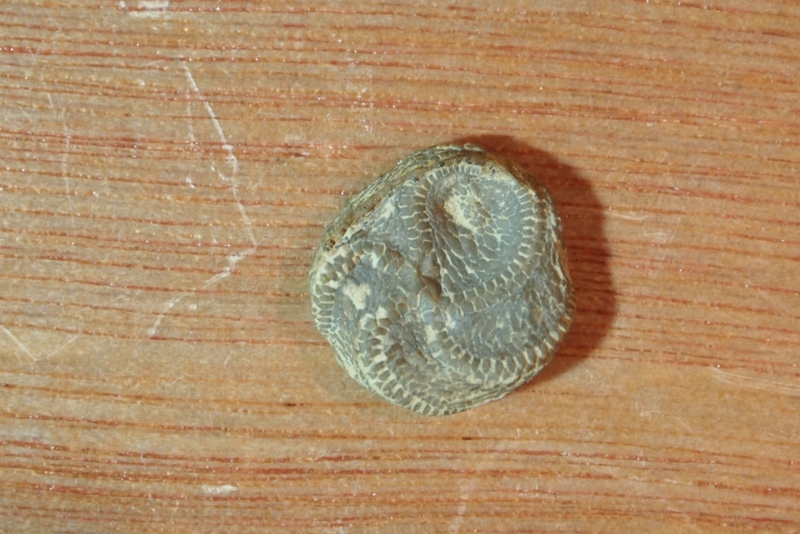
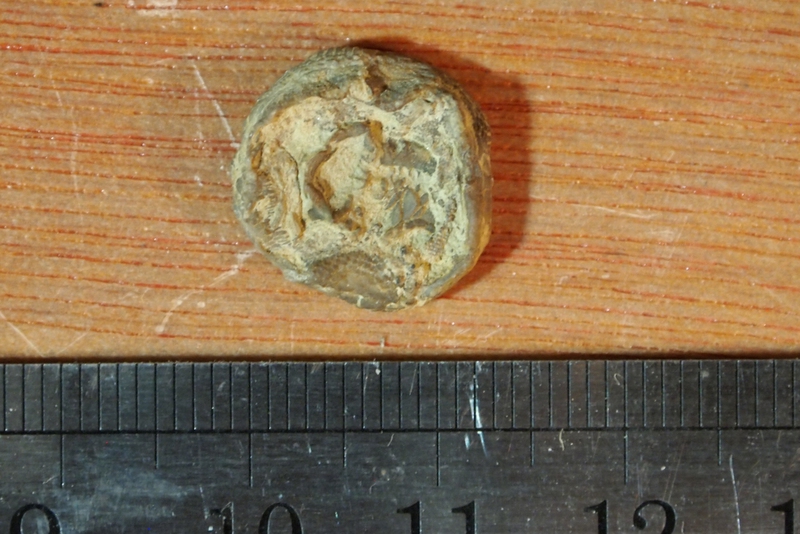
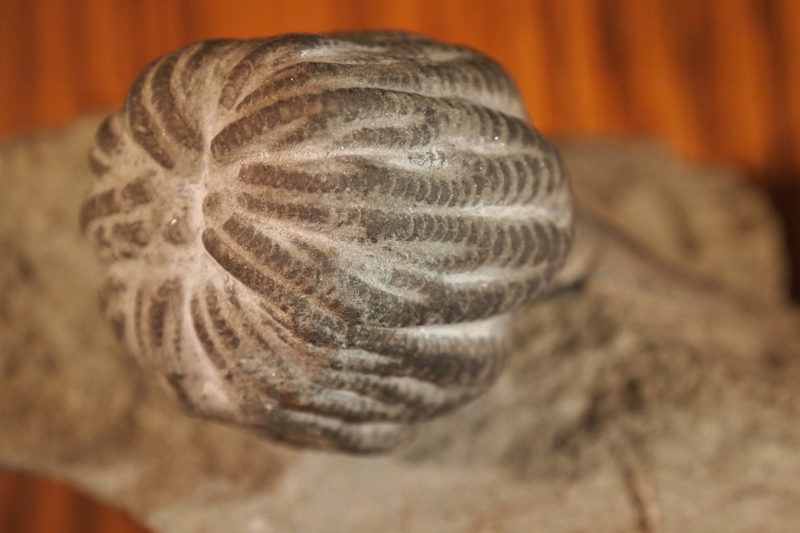
These are the only two complete edrioasteroids that I was able to find at the Bushelman quarry in Sharonville, Ohio. The larger one is an inflated Isorophus cincinnatiensis and the other an uncemented Carneyella pilea, as these echinoderms are generally found cemented to brachiopod valves, as is the case with the Isorophus. At the top of the quarry road leading up to the Corryville exposure, there existed a bench above which the channel was mined that produced the trilobites. Below the bench were sequences of grey limestones, which I considered to be a Bellevue formation equivalent, that would normally underlie the Corryville member. At the bench thin grey limestone layers were observed at the top of that sequence with Rafinesquina brachiopods. Above that were the beginnings of brownish limestone beds, which were scattered due to the quarrying. One afternoon though I was collecting with my friends Doug and Phil, and one of us noticed an incomplete Isorophus on a piece of limestone with the brachiopods. Phil and I began to scour the ground surface along the bench and another couple of broken ones were found. But as luck would have it, we both noticed the inflated edrioasteroid about at the same time, and my proximity to it allowed me to be the one who picked it up. It was free from the limestone, but has a partial brachiopod that it is cemented upon. It must have been covered very quickly to remain inflated, as they are predominantly found collapsed. The small Carneyella pilea edrioasteroid I found one day when I was by myself, within a bank of mostly loose rock that flanked the quarry along it's eastern edge. It was just a loose find, but it is the only one I have ever found. Above the horizon where the Isorophus were found, there were several thin layers in brownish to yellowish matrix contained the first of the enrolled Flexicalymene meeki trilobites, sometimes being found also within the loose mud. The layer from which the large enrolled Isotelus maximus trilobite came from was likely from this interval. The trilobites found here were rich shades of brown and very hard shelled, unlike the ones mined from the channel. Several feet above these layers I noticed a distinctive narrow interval with complete bryozoa as one would walk up the exposed hillside. There I found a large frondose piece of a Heterotrypa subfrondosa colony that I pieced together and kept, and a nice hand sized Monticulopora bryozoa that I left in place, which has a moundlike form that is normally associated with high energy. Brown shales and limestones continued up the slope of the exposure for about another ten feet before reaching the channel. The blue grey shale of the channel was exposed one day at the quarry, after some excavation had been done. I noticed the blue grey shale afterward where I found a nice large sized prone individual of Flexicalymene, although it is missing a free cheek. But that was the trilobite that initiated the hand mining of the channel. It would be sometime before I asked some of the workers if I could pay them to remove the overburden to follow the exposure into the hillside. One of the workers lived in a house next to the quarry. He offered to do the work, but he would only accept a case of beer for payment. He was an expert using a backhoe or a front loader, and he insisted that he was not only doing it for me, but also for my friend Doug whom he met later. His wife and five daughters used to entertain us in the evening sometimes when we would visit with Pete, as that was what he liked to be called. If not for the Morgans, the channel excavation would have ended once the overburden exceeded four feet without the heavy equipment. Pete and his family would surface collect the mined exposure and find many of the smaller trilobites that were within it, as the size range varied from babies to adults within the channel layers. Until then they had never noticed the trilobites at Bushelmans. Pete lamented once about how many trilobites were excavated by him without knowing they were there. I did bring him a nice sized Calymene from Yellow Bluff a few years later after I'd moved to Oklahoma, which he kept in a curio cabinet. His wife offered to return it to me after he had died, as I visited her often on my trips back to Cincinnati from California years later, but I thought it should stay within their family as a keepsake. I remember visiting Pete and his wife Betty when he had that trilobite, and I would say with tongue in cheek "Pete, where did you get that nice Diacalymene" as I used to call them. Allen Graffham called them that also, as he believed they had been improperly described. And it would not surprise me if he was correct. He was the leading authority on Oklahoma fossils back in the day. Below is a photo taken of the channel before excavation had to be considered. After this the layers were mined about 20 feet or so into the hillside.
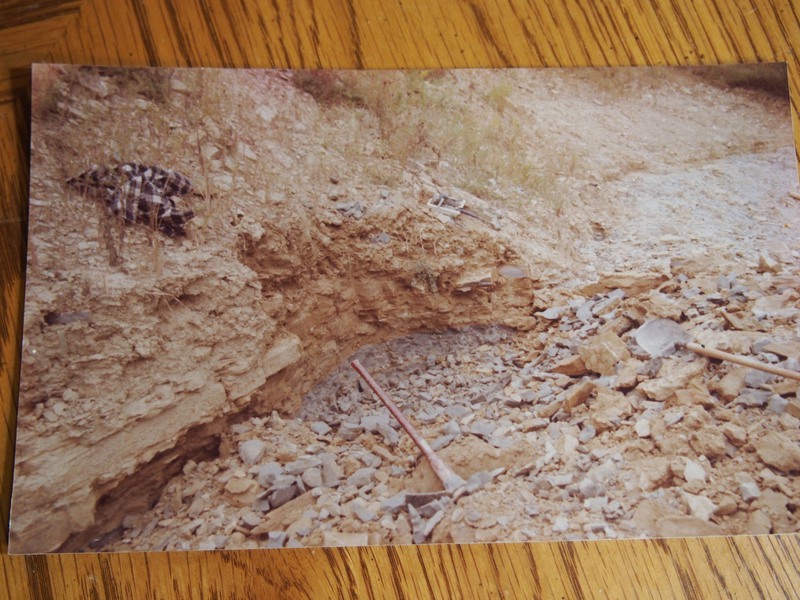
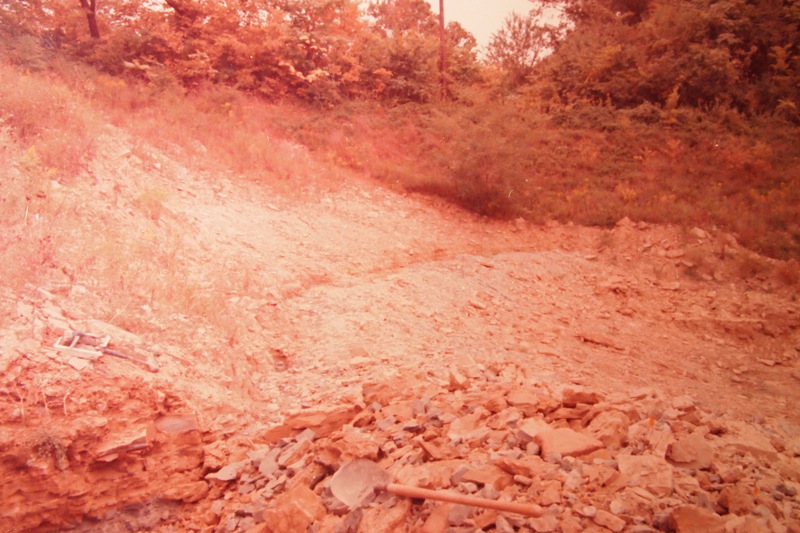
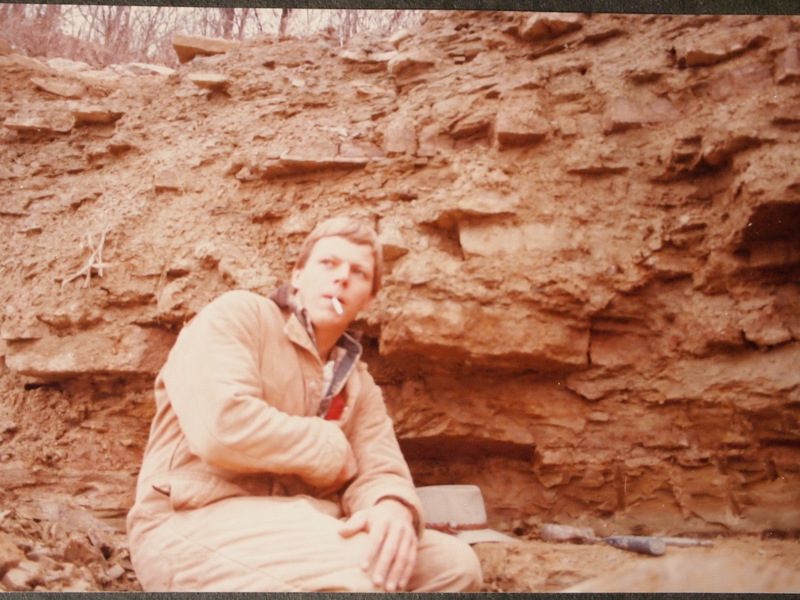
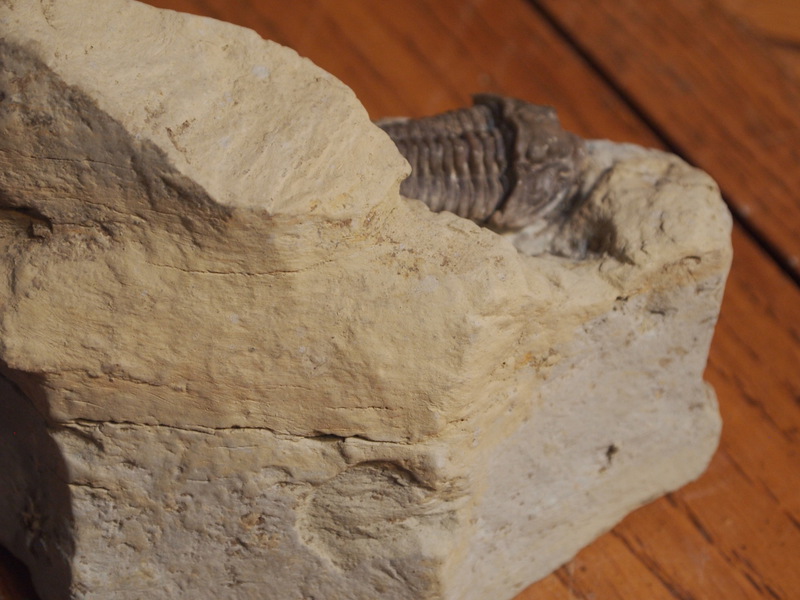
The photos above show the Bushelman quarry deposit that was mined for Flexicalymene meeki trilobites beginning in 1980. The western limit of the exposure is near where the digging is shown, and the eastern limit is at the right edge of the third photo. The selfie was taken in 1982 after quarrying had ceased. A typical larger sized Flexicalymene meeki trilobite is shown as found within the blue grey blocky matrix. Another one after preparation is also shown. Lastly, the upper contact with the brown matrix is shown having a right side up trilobite along the contact with the blue grey shale. The thickness of the blue grey lithology was about 2 feet, with an upper and lower section, divided by a thin hard calcareous shale. Trilobites varied in size from babies to large adults. Prone trilobites were upside down about two thirds of the time, and the largest individuals were generally within the lower thickness. The thin calcareous layer did have trilobites on rare occasions. One large enrolled trilobite and one cluster of seven trilobites, right side up and prone,with one medium large individual and six smaller ones. Enrolled trilobites within the layers featured various stages of enrollment, as if the current had more to do with it that the will of the trilobite. It is assumed that the sediment flow was overwhelming to the trilobites and episodic, covering them quickly when it occurred.
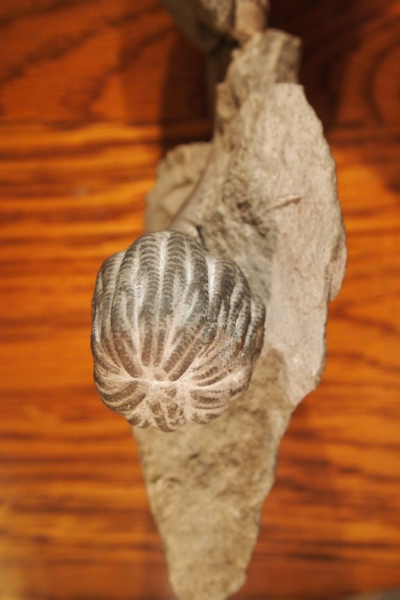
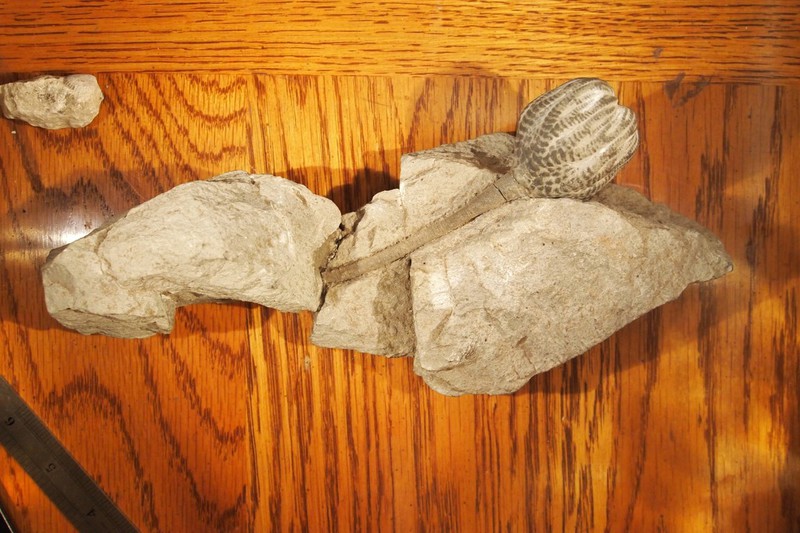
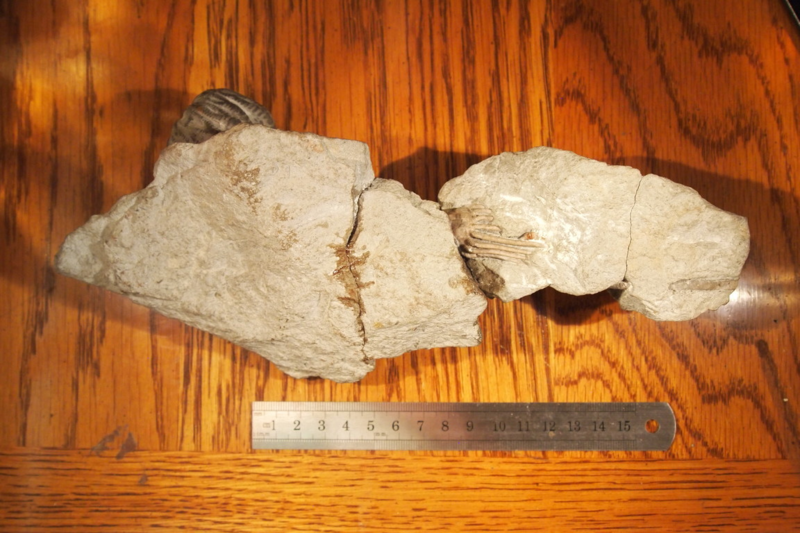
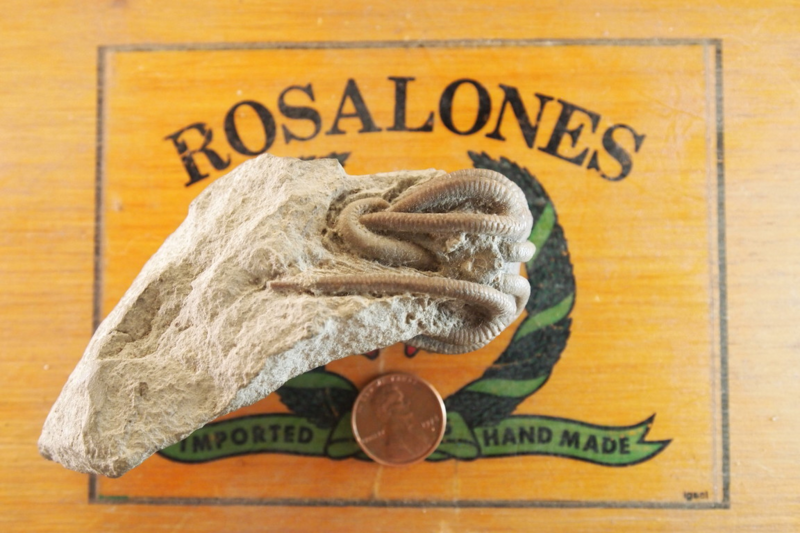
In 1979 I discovered two crinoid nests as they were once called, within the historic Crawfordsville, Indiana crinoid area. One was within a brown siltstone, the other within a blue siltstone. The events leading up to their discovery I can remember clearly, although they were preceeded by other ventures taken on a previous weekend within the area. The story begins though with the publication of Lane's monograph on Crawfordsville crinoids that had been recently published at the time. I had bought it after my first year of graduate school at Miami University. Prior to that though I had had some dealings with Dr. Lane and one of his students. Dr. Lane had sent me two letters during the summer of 1977 before taking classes at Miami. I did not really know who he was, but he was encouraging me to apply for graduate school at Indiana University in Bloomington, Indiana. As I had applied to U.C. and Miami, I was happy that I had been accepted at Miami. I was not accepted at U.C., and my mentor Dr. Meyer told me that he and Madelaine Briskin wanted me, but the others in the department did not. After getting Lane's monograph, I realized who he was though, and I reasoned that Dr. Meyer had told him about me, as one echinoderm specialist to another, which was nice of him to do. I was to follow in his footsteps regardless. My first brush with the crinoids from Crawfordsville came during the spring of 1978. I shared an office suite my freshman year with four other students. One graduated that spring, and I think he was heading for a job in Texas. One day I had shown Mark the large enrolled trilobite from Stonelick Creek, and I guess he really liked that Flexie, as he later brought a large Platycrinites crinoid to the office one day to offer in trade for it. It was a nice one as big as the largest ones I found, for the most part. It maybe had a small piece of the stem. At the time I figured it was worth more money than the trilobite, but I told him I would never trade that trilobite, so that was the end of that. But it turned out that Mark had done his undergraduate work under Dr. Lane at Bloomington, and he had found the crinoids while at school there. In curiosity, I asked him how to find crinoids there. His answer was poignant for me as it would turn out. He said "Look in the ravines." When I came back to Miami in the fall, I believe that was around the time that I learned of Lane's monograph. After getting it, I could not stop reading over the historical portion at the beginning. Several men were discussed along with their exploits. One I noted particularly though, as he was the only source for crinoids found at Indian Creek. His name was Beechler, and the crinoid deposits that he found there he called nests. The distribution of the crinoid nests were within a smaller sized area than had been witnessed for the crinoids at Crawfordsville, and I think were cited as about 20 feet wide. I noticed that Beechler died at an age around 30 though, and I reasoned that he certainly could not have found all of them then. As luck would have it, after the quarrying at Bushelmans had begun, I began visiting a shop within the Union Terminal building of Cincinnati, where the museum is now. Back then it was used for business, and there were a number of shops to buy things, with an upper level and a lower level. The fossil shop was in the lower level, and was actually run by a former graduate of the geology department at Miami. I learned that his name was Sandy, and he had some nice trilobites there that I was able to trade Flexicalymenes from Bushelmans for. Most were enrolled ones from the overlying brown shale, but one came from the mining that was unique. I regret parting with it, as it was somewhat golden, with a thin exoskeleton that I thought was in it's early forming after molting. I acquired four nice enrolled Silica Devonian trilobites though. One day he had a Macrocrinus mundulus crinoid in a small piece of matrix for sale, from the Mississippian age of Indiana, found at Indian Creek. I learned that he had got it from a fellow named Bob Howell who was finding them there. That meant to me that someone was still finding Crawfordsville crinoids, as I had no idea really at that time. I bought it from him and Sandy gave me that information when I asked, and I did eventually get Bob Howell's phone number as well. I believe I eventually went to Crawfordsville over the summer after my second year of graduate school. That first trip I was driven by my friend Phil one weekend, and we went to different sites listed in Lane's monograph. I did find one crinoid crown the second day at a random stop at an exposure we saw near Indian Creek. It was a lone Agaricocrinus splendens crown, partially pyritized, and found in place within a bank along a stream that was visible from the road. I cannot recall where it was though, and no other sign of a crinoid cup was there, like I was expecting. I spent time cleaning it with the end of a Bic pen cap during the drive back to Oxford late Sunday afternoon. Our next excursion to Crawfordsville happened the next weekend I think, and my friend Doug was along with us. I did the driving and I decided to take us to Indian Creek. We eventually found a crossing where we could park, and a small house was nearby along the creek. We asked for permission to access the creek and it was granted. That was the Saturday that began it all. On the following Sunday though, the two crinoids shown above were found during the beginning of the excavation of the blue lens.
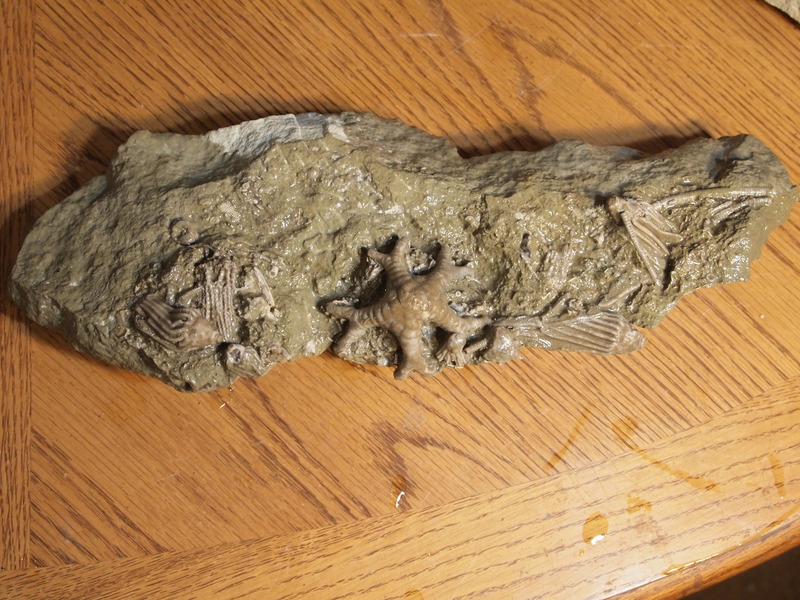
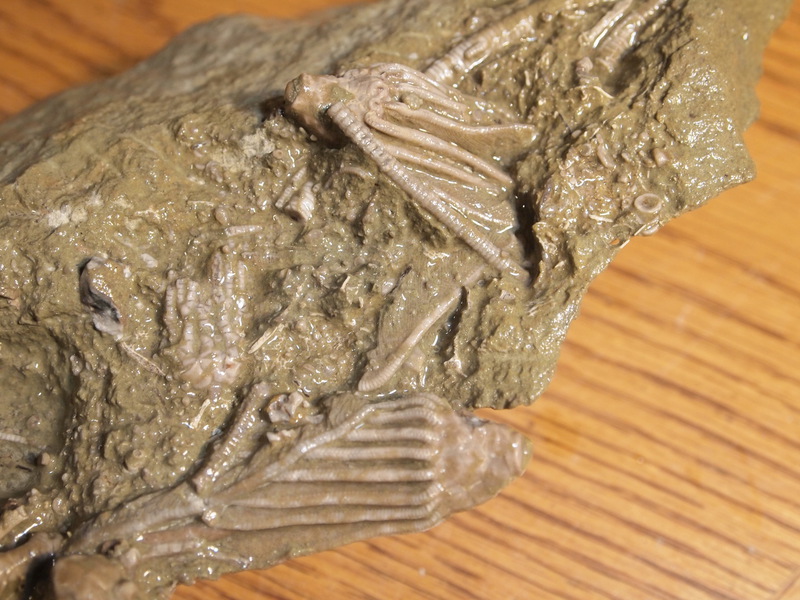
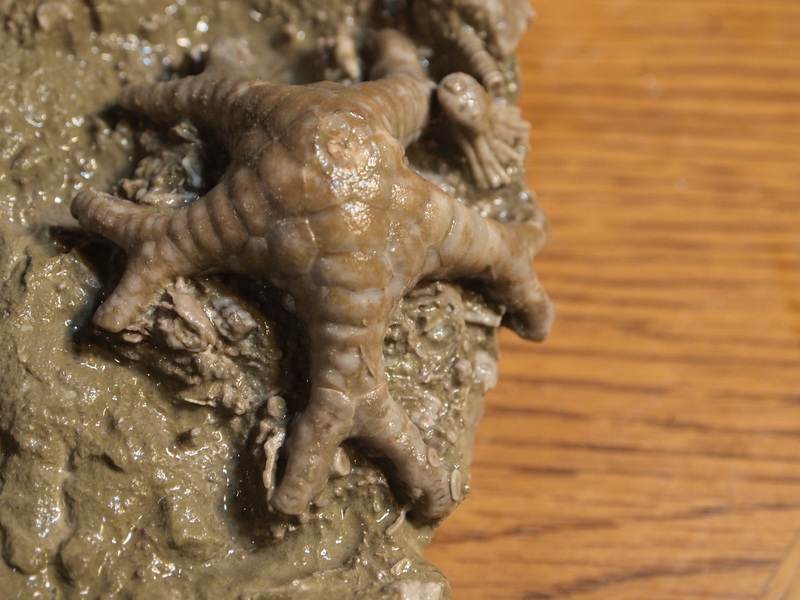
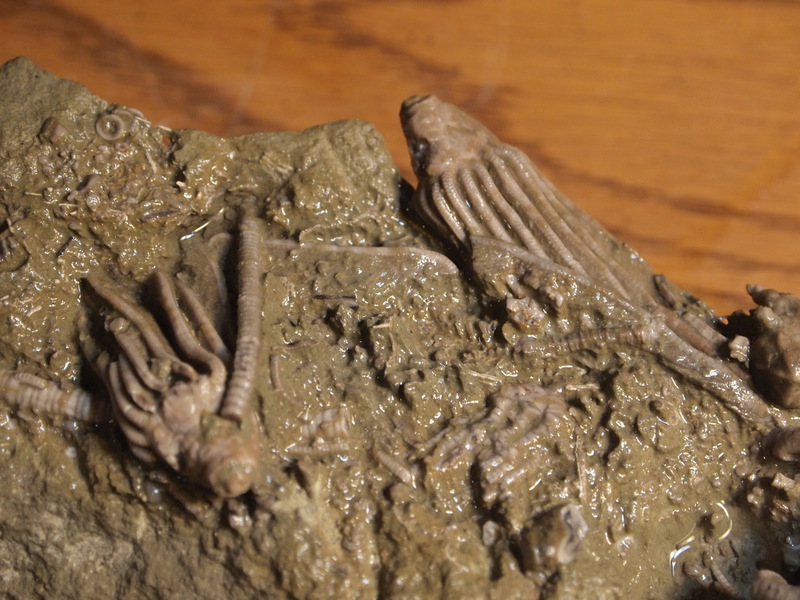
This is one of the last pieces that I mined from the brown lens that I found at Indian Creek. The first piece that I found is a Forbesiocrinus multibrachiatus crown broken from the stem that I noticed while walking up a draw where a ravine emptied into Indian Creek. I was maybe 30 feet higher than the creek within a ravine when I saw the arms lying within a flat surface exposure by the southern edge of the ravine. I dug it out but I didn't see any other crinoids at the time. As it turned out, I was trespassing, as I had headed up from the creek crossing where we'd parked that Saturday after exploring the south side where we had been granted access. There was a home along the south side of the creek as I wandered up to where the brown lens is, which was across the creek from where the ravine was. I shouted loudly at my friend Doug as I was walking back to the crossing where we'd parked, as he was standing on the bridge far away looking at me. I yelled "Oh, no!" several times. And although I showed the Forbesiocrinus crown to my friends, we did not go back up the creek that day for another look. Instead we spent our time searching a long winding ravine down the creek off it's northerly side that we'd spent some time at early in the day. It was after my fourth trip up it that Sunday afternoon when I found the blue lens. There were many twists and turns within that generally 20 foot wide ravine, with some particulaly unusual looking spots with plenty of exposure concerning the siltstone. I began feeling that the area had a very familiar presence, as if I'd been there before somehow. At the top where it flattened out into the surrounding countryside, full of trees and small hills and dales, it was evident that someone had mined for crinoids there. For along the eastern side of the ravine, within a low lying exposure, evidence of mining was seen. I also found a small knife nearby, stuck within the outcrop. It was very old, and I took it to be a marker, which I then took to keep for myself. My two friends had proceeded to try and mine that spot, but the crinoid layer was thin, and the other thin beds overlying it were difficult to remove, and we had no mining equipment at the time. But that kept them busy. Eventually the end of the afternoon approached and the consensus was to call it a day. Just as we began to leave to descend the ravine, I stopped along it's southern exposure where some scattered crinoid fragments were showing in the rock. Nothing unusual or very interesting, but I had noticed it before and I commented to my friend Doug as he was walking ahead of me that I wanted to stop and just take a look at it. I spalled off a piece of matrix about a foot long and turned it over, and there I saw a Macrocrinus crown, and I shouted with excitement "Oh no, I found a Macrocrinus!" as I held the piece up in the air. Doug was about 35 feet away and showed me a frown as he thought I was kidding. But then I spalled out another piece and there was another Macrocrinus, for which I yelled "Oh no, another one!" Doug was still frowning as he walked back to where I was, and then began the feeding frenzy. I told him he could have the spot to the right of what I'd found, as I began washing the two found pieces in the water of the ravine. But he instead took the next piece below where they had been found and it had a Forbesiocrinus showing with a length of stem and he began dancing and shouting with glee. Only now I was dumbfounded thinking to myself that that was my piece, although I said nothing. Then we began prepping the spot for additional excavation. Sometime afterward Phil joined us, and when the first few pieces of rock were spalled off the side of the ravine there, the bottom of an Agaricocrinus crown and the top of a Taxocrinus crown were showing within the exposure. I picked them out with my hand, both nearly free of matrix, and they were later placed in a small cloth bag. The Agaricocrinus had no stem, but did have the starfish inside. About 8 inches of the Taxocrinus stem were later recovered during further excavation. Eventually we decided it was time to leave and it was a long walk back to the car. We took what we could carry and then we had to return to get the rest that late afternoon. We set everything near the house before heading back for the rest of what we'd found. Upon returning though, I noticed that the small cloth bag with the two crinoid crowns was missing. The young lady who lived at the house had several small children and a small dog playing outside, and the kids offered to help find it for us. After about a long half an hours time, they finally found it by one of the posts of the decorative fence around their yard. Apparently the dog had taken it there for safekeeping. I was greatly relieved that it was found and that I had my prize crinoid finds back. As the saying goes, all in a good day's work. And that was a good day's work I'd say, and a very good weekend as well.
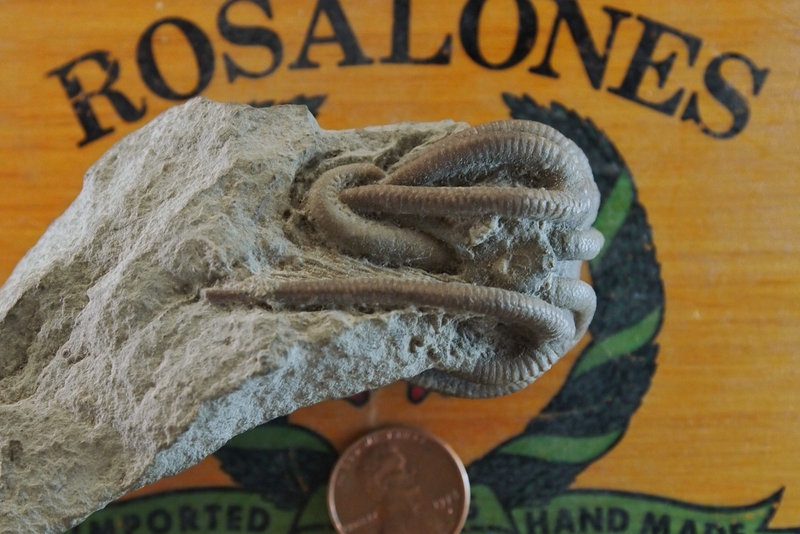
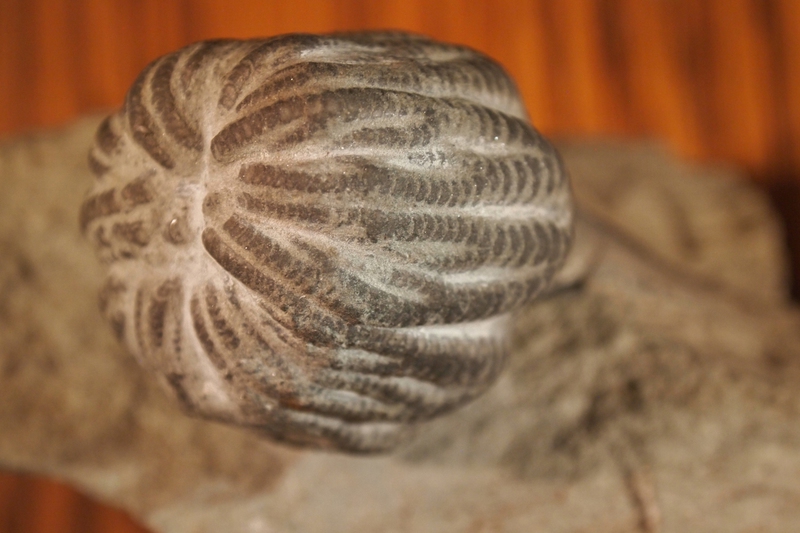
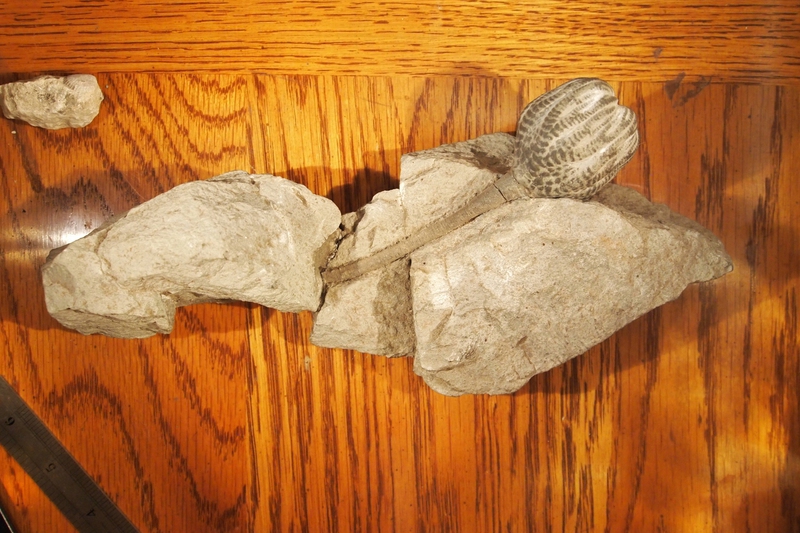
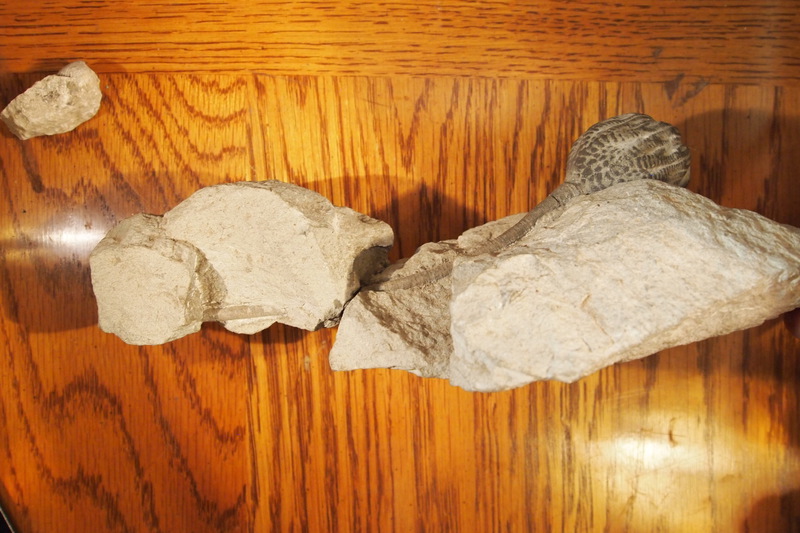
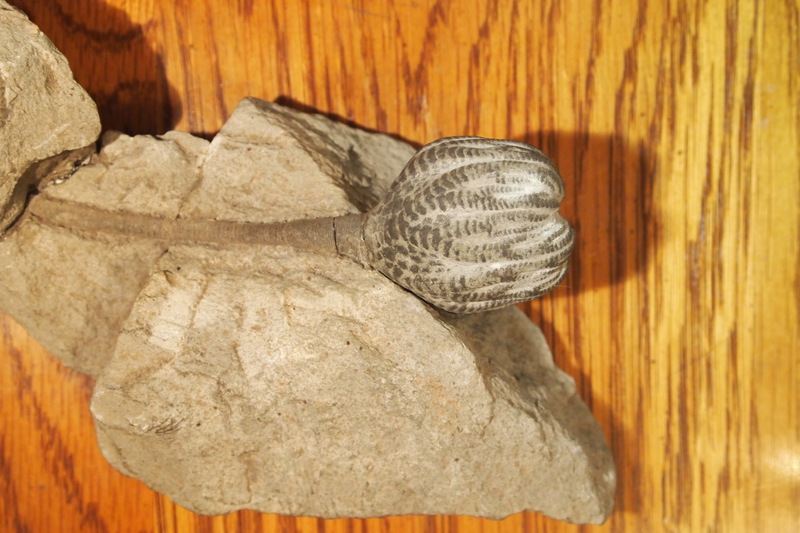
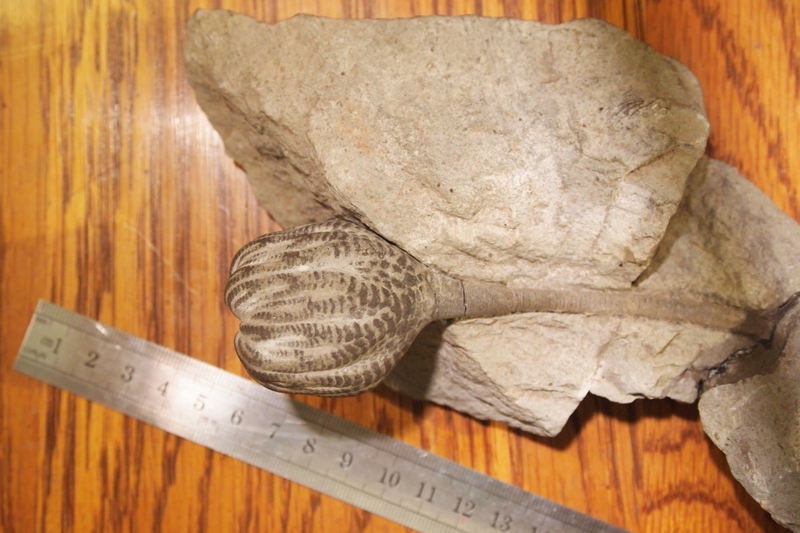
These are the two crinoids that were found that first day at the blue lens. It was only following the second trip that things became problematic. My mistake was in arranging a trip to visit with Bob Howell. Although it was very informative for me, it was informative for him as well, and thereby came the loss of the brown lens. While we were at Bob's house, he lent his time by showing us one tray after another of beautiful crinoids from within his cabinets. His specialty was lengths of stems with intact crowns of which he had many. Most were pieced together from hand mining. I showed him the two crinoid crowns above from the blue lens, and the Forbesiocrinus from the brown lens, as well as the knife I had found. He said that the knife was his that he left to mark the excavation we'd found. He asked where I had found the brown piece and I told him. I did notice that he had no brown pieces within his large collection. But he did have some nice big Dipleura trilobites and a large enrolled Silica Phacops sitting within a large block of matrix, totally unprepared. Some amazing stuff he had traded for over the years. It was during our next trip to Crawfordsville that the problems began. I spoke with Bob again on the phone before we started collecting. It was then that Bob informed me that where the brown lens was I had trespassed. He also said a sheriff lived in the house across the creek from it, and that he had informed him about me. So I was basically told that I was not welcome there. What I wasn't told was that Bob was taking over that site to begin his own quarry. I learned that he'd quit his job within the next six months, and he went on to sell crinoids from there as his next vocation. I did visit the quarry about a year later with my friend Frank one day when I was visiting Ohio while living in Oklahoma. We were actually given permission toncollect after visiting the owner's home that we were able to find. The husband was not at home though and his wife gave us the permission. I was stunned by the width of the excavation, as it was about thirty feet in width. We did excavate some crinoid blocks with the help of the portable saw and sledge hammers. But only after the husband came by around lunchtime to tell us his wife had made a mistake by letting us come there and that the property was leased. I asked if we could finish extracting the pieces we'd been working to free and he obliged me and was genuously nice about the whole thing. then Frank offered to buy the land for 2000 an acre but the fellow just smiled and shook his head no. I returned to the blue lens once in 1995 with my Nikki and the portable saw in hand, and after digging out the area to find the lens, I retrieved two small blocks with crinoids using the saw. One of those I began to work with a few years back. Full of crinoids as expected. The remaining crinoids at that site will have to remain there forever as I returned again in 2016 with my friend Jason then. I spoke with the lady that gave me access the first day there at the house and learned that the property where the lens is was now owned by the Indiana Park System. The last of the two brothers that had owned it sold it to them before he died. That would have been Bryce Williams. The other much taller brother was named Dean. I met them after finding out the lens was outside of the area included with the house we parked near. After that I would park near their house as they did not mind me being there. I was so relieved to know that after meeting them. What stuck with me though was how much Dean looked like Jack Palance, and he was smiling like him when I asked for permission to mine the crinoids. After that the place became like Heaven to me, and the shades of green within the trees there is a testament to that. Indian Creek is actually within a canyon below the flatland below. You become aware of that as you descend the winding road from the flatland above to the bluff sided creek below, with the bluff along its' northern side. The creek runs east to west at that point. The forest below is within its' own microclimate and environment. It is kind of akin to the James Mason movie Journey to the Center of the Earth when arriving there. Jules Verne would have liked the scenery at Indian Creek. The shades of green are unlike anything I'd seen before or after in my life. It is a lovely place to be.
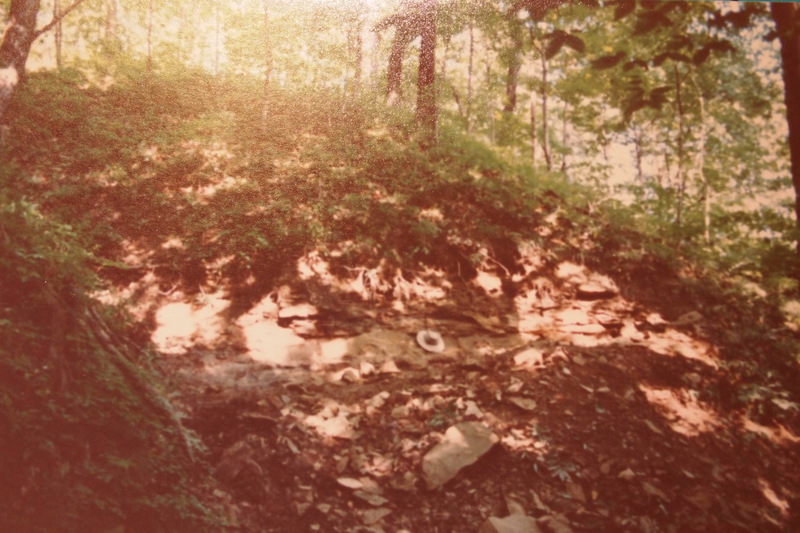
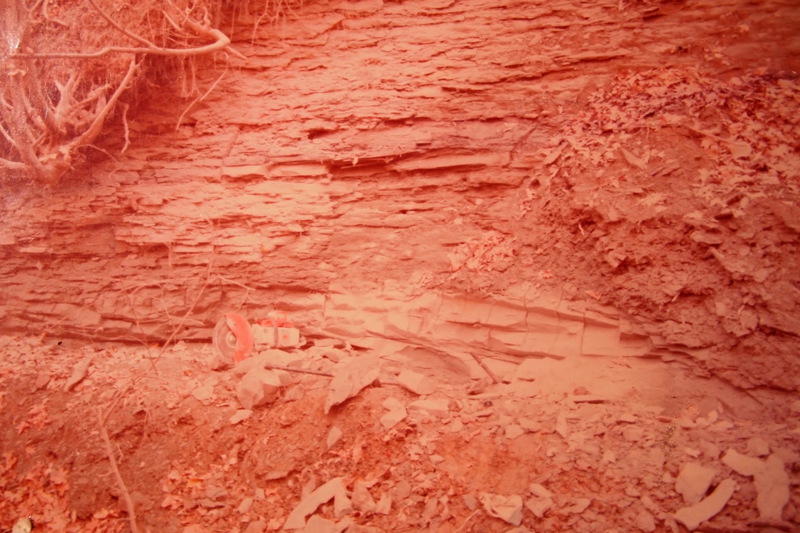
These are the two localities at Indian Creek that I found in 1980. The brown lens on a Saturday, and the blue lens on the following Sunday. The photo on the left I took on the day when Frank and I were allowed to collect there. I have no photo from the day of discovery. It was just a quiet natural setting. When I found it, I didn't know I had found it. My friends looked at it afterward and found some nice pieces before they were escorted away. The photo was taken probably in 1983, and was the last time that In saw it. The center photo is of the blue lens taken during the summer or 1982. After moving to Oklahoma at the end of 1981, I returned four times to the blue lens in 1982 during April, July, August, and October. Each time I was accompanied by a helper except in October. The photo shows the maximum extent of the mining which covered the width of the lens. The crinoid deposit extended 6 to 8 inches above the bottom of the 24 inch siltstone bed that they were within, but thinned to only about three inches toward the edges of the expanse. In this case, a width of 20 feet for the this nest would be as per the historical record accounted for by Dr. Lane, whereas the brown lens appeared to span closer to 30 feet per its' photo. The last photo of me working the blue lens by myself in 1995 was taken during my last visit there by Nikki that day.
Wildlife
Check out some of the interesting denizens of this locality and also enjoy the gallery of specimens within the virtual museum!
Get Social with Us
Like us on Facebook and get 10% off your next order.
 Share
Share Print
Print 